Thursday, November 22, 2012

The Road to Revolution

I really liked this little game! One fun fact that I learned while playing was that Thomas Paine was a corset maker. This is ironic because he created the document common sense.  You would think it would be commons sense not to suffocate the women. Then again they may not have known that back then.

I would have liked to use this interactive game in our unit plan, but we did not cover a lot of the information the questions are detailed with.  I thought it was great that the students had something to look forward to. When they finished all the questions they made it to Washington DC and liberty.

Try the game and test your knowledge of The American Revolution!


Video Story Problems

Video Story Problems  are a very clever way to introduce a problem to your curious students. It's different and will definitely catch your students off guard. A video story problem can take place anywhere at any time. Many teachers use their iphone or any other type of device that records to create their problem. I have created my own video story problem! You can view it below, comment if you know the answer :) Good Luck and think outside the box!


Sunday, November 18, 2012

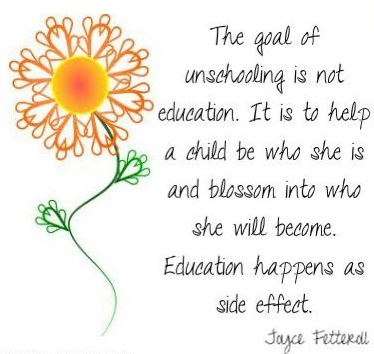
The Philosophy of Unschooling

What in the world is unschooling? Unschooling is an educational philosophy that provides for more freedom than any other learning method, and prepares kids for an uncertain and rapidly changing future better than anything else I know.

Unschooling is a form of homeschooling except the classes do not have subjects, the children set their own goals, the children are in charge of their own learning, learn to think for themselves instead of following directions, and anything can be used to learn such as a museum not just textbooks.
Unschooling can be done anywhere, it does not have to take place between 8am and 4pm in a certain building. The world is theirs to explore.


Unschooling takes a different approach: kids learn how to learn, how to teach themselves. If you know how to learn and how to teach yourself, then you are prepared for any future. If in the future the things we know are obsolete, then the person who knows how to learn anything will be ready to learn whatever is in use in the future. The person who only knows how to learn from a teacher will need a teacher to teach him.


I personally do not agree with unschooling. Unschooling will put billions of teachers out of a job. Also all the money those teachers spent on becoming the best educator possible will go to waste and they will be stuck in debt. Not everyone can be an entrepreneur. What happens when your child wants to go on to college, and has been unschooled their whole life. The child does not have a high school diploma or a GED, the first step in applying to college. Everyone needs a degree if they want to be somewhat successful in the real world, and a doctorate if they want to make a decent paycheck. If you put a student in a classroom who is unfamiliar with how a classroom is run, then that student will be destined to fail. Teachers are not teaching your child how to be a robot, they are showing them how to interact in society while helping them learn useful skills such as reading, writing, analyzing, and experimenting. A child who goes to school can do everything a child who is being unschooled does. 


Native American Project

In class, we were asked to research one Native American Tribe. Our main goal was to figure out how geography influenced the Native Americans. Please look at the exquisite powerpoint my partner Barbara and I made :) The Tlingit Tribe . It is filled with copious amounts of information and educational videos describing why the Tlingit people are the way they are. 

This is our outline if we were to present to the class-explaining each slide more in depth:

The Tlingit Tribe: The Influence of Geography

Pronounced ‘TLIN-git’ or ‘KLIN-kit’


1.  Location:
  • The Tligit people occupy the Pacific Northwest Coast, the area known as SouthEast Alaska

  • This area covers the narrow coastal strip of the continental shore along British Columbia. Tlingit communities are located from just south of Ketchikan and are scattered northward across islands and mainland as far as the Icy Bay area. Tlingit people also occupy some inland area on the Canadian side of the border in British Columbia and the Yukon Territory about 40,000 square miles.
Migration:
  • Tlingit Indians and their ancestors inhabited much of what is now Glacier BayNational Park and Preserve, with both permanent and seasonal settlements.  Food and other resources were abundant.  The small population of Tlingits thrived, living close to the land, and a rich culture developed.
  • Near the end of the Little Ice Age, about several hundred years ago, advancing glaciers forced the Tlingit people to abandon their villages and move to Hoonah, across Icy Strait from Glacier Bay.  Today, Hoonah Tlingits still regard Glacier Bay as their ancestral home, and feel a special connection to it.
 The Land/Food and  Trade
  • The coast is covered with mountains and forests
  • Located near the Gulf of Alaska, includes islands and one of the largest temperate rain forests in the world
  • Because of the area people hunt deer, mountain goats, caribou and moose.  The Tlingits are also master fisherman because of the close proximity to the water and eat salmon, halibut and shellfish.  The people often use canoes to hunt seals, sea
  • lions and otters.
    3.  Culture
    • Language:  Tlingit is a complicated language with many sounds that do not exist in English.  There are unique geographic references embedded in personal names, clan names and house names.
    • Totems/carvings:  Made from wood because of the bountiful supply in their environment.  Contained symbols that told the history of individuals or of the family.
    • Religion:  The Tlingit have a long history and connection to the land, they believed in spirits all around them, that may inhabit animals or objects.  Because of their beliefs, they respected all things in the universe.  Tlingit were influenced by the Russian Orthodox missionaries and many converted to Christianity after their medicine men were not able to cure outbreaks of smallpox.  The picture in the Prezi is of the Gyhldeptis (gill-dep ‘tis) Tlingit goddess of the rainforest.
    • Legends:  The legend of the Raven is very present in a number of stories and traditions.  It is the Raven who is the symbol of creation, maker of forests, mountains, rivers and seas; describing the area of the Tlingit people.  The Tlingit have a strong oral storytelling tradition.  One legend is, “How Mosquitoes Came to Be.” (link in Prezi).  There is a strong sense of family history.  Each family crests have stories and songs associate with it, the crests are sacred to family members.
    • Ceremonies;  The Potlatch is one of the elaborate ceremonies.  A potlatch is a giant feast that marks a time for showing respect, paying debts, and displaying wealth. Potlatches are given for various reasons and may be planned for years in advance. The most common potlatches given today are funeral potlatches, the 40-Day Party, memorial potlatches, adoption potlatches, naming potlatches, totem-pole-raising potlatches, and house- or lodge-building potlatches.
    • The Tlingits were also known to be fierce warriors. When the first Russians tried to settle in Sitka, the Tlingits drove them out, despite the guns and cannons brought by the intruders.
    • Tlingits also made wood masks that they used at ceremonies. The masks depicted birds and animals. Beads, feathers, and furs decorated their ceremonial costumes.


      • Games:  The Tlingits enjoyed playing games. Many of them involved gambling. The stick game was one. Several sticks in a bundle were marked. Then, through manipulation and guessing, players tried to collect all of the marked sticks.  Children played with dolls and toys.
      4.  Clothing/Homes:
      • Clothing:  -->men usually wore only breech cloths -- in colder weather pants and moccasins -->women only short skirts made of cedar bark. and in the colder areas they also wore longer deerskin dresses.  For formal occasions the people wore more elaborate outfits, with tunics, leggings and cloaks painted with tribal designs-->Chilkat blankets (woven from cedar bark and mountain goat hair) -->men and women sometimes worebasketry hats
      • Lived in rectangular cedar-plank houses with bark roofs- up to 100 feet long-filled with about 50 people-everyone(today they live in houses just like everyday people)


    Pinterest?!?

    Pinterest is a nifty website I heard about months ago, but just recently I heard that it can be used for teaching. It's a photo sharing website that allows users to create and manage a theme based image collection. 

    My personal collection is labeled Social Studies Common Core. My main focus is finding activities that I can use in the classroom. 

    My professor also has a Pinterest. You can follow her page as well.

     Pinterest is probably one of the best websites I have ever found for education. It helps that all the users are teachers and teacher candidates. Everyone is extremely  creative and nice enough to share their awesome ideas with the world. This blog shows teachers 16 different ways you can use pinterest. The internet can be such a great resource! 


    Using the Common Core in the Classroom

    The common core is a touchy subject around teachers these days. Many love the new ideas and others are having difficulty assimilating. This video is a summary of what the new standards are like. Before you listen to someone else's opinion, listen for yourself.


    How do the new standards change what is being taught in schools today.
    The emphasis is on deeper thinking, analysis, and problem solving.
    Does my evidence support my claim, does my evidence count as good evidence?
    In math it's not just what's the answer, it's the process of finding that answer.
    For english language arts, it's no longer about reading the book and taking a quiz. 
    Focus on the difference between tone and theme.
    Putting the common core standards into practice.
    A teacher using the common core

     Using these standards, teachers really have to use their brain and think of creative activities that will emphasize deeper thinking, analysis, and problem solving. The students and the teachers are both learning new things at the same time. We are all trying to make each other better! 

    American History for Curious Thinkers

    Social Studies is a very important subject to teach. It is essential for teachers to do their research and make sure that what they are teaching is historically correct. With all the new internet sources out there, it is difficult for everyone to distinguish what really happened in the past. Here is a great timeline for teachers to reference on the topic of American History. It starts with 1780 and ends with 2010. This timeline is educationally enriching, because it not only tells you the year and what happened, but it also talks about the state, territories, presidents, society, native american impact, the world, science, and culture. All of the facts are incredibly interesting and will definitely spark conversation between your students! I definitely plan on using this timeline when I teach American History.


    Part of the timeline seen on the website :)